
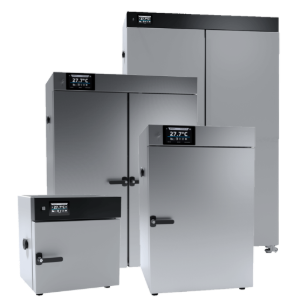
Forced Convection Ovens in NZ: Choosing the Right Lab Drying Oven
Forced convection ovens are a go-to choice for laboratories because the fan-assisted airflow helps maintain more even temperatures across shelves and improves recovery after door openings. If you’re drying glassware, conditioning samples, curing coatings, or running routine QC work, this style of oven is often the best all-round option.
This guide explains what to look for, how to choose the right chamber size, and how the main forced convection oven ranges available through Interlab compare.
Browse the range
Why forced convection?
Compared with natural convection ovens, forced convection models circulate air continuously through the chamber. In day-to-day lab use that usually means:
- more even temperature distribution across shelves
- faster recovery when the door is opened
- more repeatable drying/conditioning outcomes with multi-shelf loads
What matters when choosing a forced convection oven
1) Temperature uniformity (across shelves)
Uniformity matters more than the displayed setpoint. If you load multiple shelves, run consistent methods, or want repeatable results between runs, forced convection is a major step up for maintaining stable conditions throughout the chamber.
2) Chamber size and airflow space
The most common sizing issue is choosing based on “how many items fit” rather than “how well air can circulate”. Leave space around trays and samples so air can move freely. As chamber size increases, airflow design and fan configuration become increasingly important for uniformity.
3) Controller features and how you work
Some labs need simple, repeatable heating. Others need programmable profiles, temperature ramps, alarms, or easier operation across multiple users. The controller can be the deciding factor if you’re running profile-based workflows or want more usability and repeatability.
Interlab forced convection oven ranges: what to choose and why
DAIHAN forced convection ovens (ThermoStable OF series)
The DAIHAN OF series is a strong “default choice” for many labs. They’re known for a quality build and are manufactured in South Korea. For general lab drying, conditioning, and routine workflows, the OF series offers a dependable balance of performance, control and value.
View DAIHAN forced convection ovens (OF series)
DAIHAN SMART forced convection oven (ThermoStable SOF)
The DAIHAN SMART series is built on the same quality platform as the OF series, but adds a touchscreen interface and extra usability/features. This can be particularly valuable if multiple people use the oven, or if you want more control over temperature programming.
SMART models are well suited to labs that want features such as temperature ramping parameters, easier profile setup, and a more streamlined user experience.
View DAIHAN SMART forced convection oven (SOF)
POL-EKO forced convection drying ovens (SLW series)
POL-EKO ovens are a step up in overall quality, features and finish. Manufactured in Poland, they’re a great option if you’re looking for a more premium oven with excellent performance, strong usability, and modern touchscreen controllers.
They’re a great fit for labs that value higher-end features, robust build quality, and an oven that’s designed for frequent use and demanding workflows.
View POL-EKO forced convection drying ovens (SLW series)
DIGISYSTEM forced convection ovens
DIGISYSTEM ovens are a popular choice when you simply want to meet common lab requirements without paying for extra features you don’t need. Manufactured in Taiwan, they are intentionally more basic compared with premium lines, which makes them attractive when the priority is straightforward forced convection heating and drying.
For many labs, the most popular DIGISYSTEM options are in the 20–50 L range, where they cover most everyday needs in a compact, cost-effective format.
View DIGISYSTEM forced convection ovens
Which oven should I choose by size?
20–50 L: compact ovens for everyday lab needs
If you want a compact forced convection oven for routine drying and general heating workflows, the DIGISYSTEM range is a popular pick in the 20–50 L size bracket. These models suit many labs that want practical performance without premium features that may not be required.
- Best for: smaller benches, lighter loads, routine drying/conditioning
- Why: cost-effective and simple to run
- Typical choice: DIGISYSTEM forced convection ovens
Around 150 L and larger: prioritise uniformity and airflow design
Once you move into larger chamber sizes (around 150 L and above), uniformity depends heavily on airflow design and internal configuration. If your priority is the most consistent chamber temperature across shelves, DAIHAN and POL-EKO units are typically preferred at these larger sizes because their air circulation design and chamber configuration support stronger temperature uniformity.
- Best for: larger loads, multi-shelf use, busy labs, workflows sensitive to uniformity
- Why: more refined airflow circulation and chamber configuration for improved uniformity
- Typical choices: DAIHAN OF series or POL-EKO SLW series
If you expect growth or frequently run high-volume drying cycles, POL-EKO also offers larger capacity options, which can be useful when you want to size once and avoid needing an upgrade later.
Common applications for forced convection ovens
- drying glassware and laboratory equipment (where appropriate)
- conditioning samples prior to testing
- curing coatings, resins and adhesives
- general heating and ageing studies
- routine QC drying workflows
Quick sizing checklist
- What is the biggest typical load you’ll run (shelves + tray footprint)?
- Do you need airflow space around items for uniform drying?
- How often will the door be opened during the day?
- Do you need temperature ramping / programmed steps / logging?
- Do you expect to need a larger oven in 12–24 months?
Next step
If you tell us what you’re drying/curing, your temperature range, and the approximate load size, we can point you to the best model and chamber size for your workflow.
