How to Choose the Right Centrifuge for Your Laboratory
Buying a centrifuge comes down to more than selecting the largest or fastest model. The right choice depends on what you are spinning, the required force, the rotor, the sample volume and how the unit will fit into your laboratory workflow.
Understanding these factors before comparing models can help you avoid paying for capacity you do not need or selecting a system that cannot meet your protocol requirements.
1. Start With Your Samples and Workflow
Begin with the tubes, plates or containers you use, the number of samples processed in each run and how frequently the centrifuge will operate. A compact benchtop unit may suit routine low-volume work, while larger batches or specialist applications may require greater capacity.
2. Benchtop or Floor-Standing?
Benchtop centrifuges are practical where space is limited and sample volumes are moderate. Floor-standing models provide greater capacity and may suit high-throughput laboratories, but they require more room and may have additional installation considerations.
3. Compare RCF, Not RPM Alone
RPM describes how fast the rotor turns. RCF describes the force applied to the sample and depends on both rotor speed and radius. Two centrifuges operating at the same RPM can produce different forces, so protocols should be matched using RCF wherever possible.
4. The Rotor Sets the Practical Limits
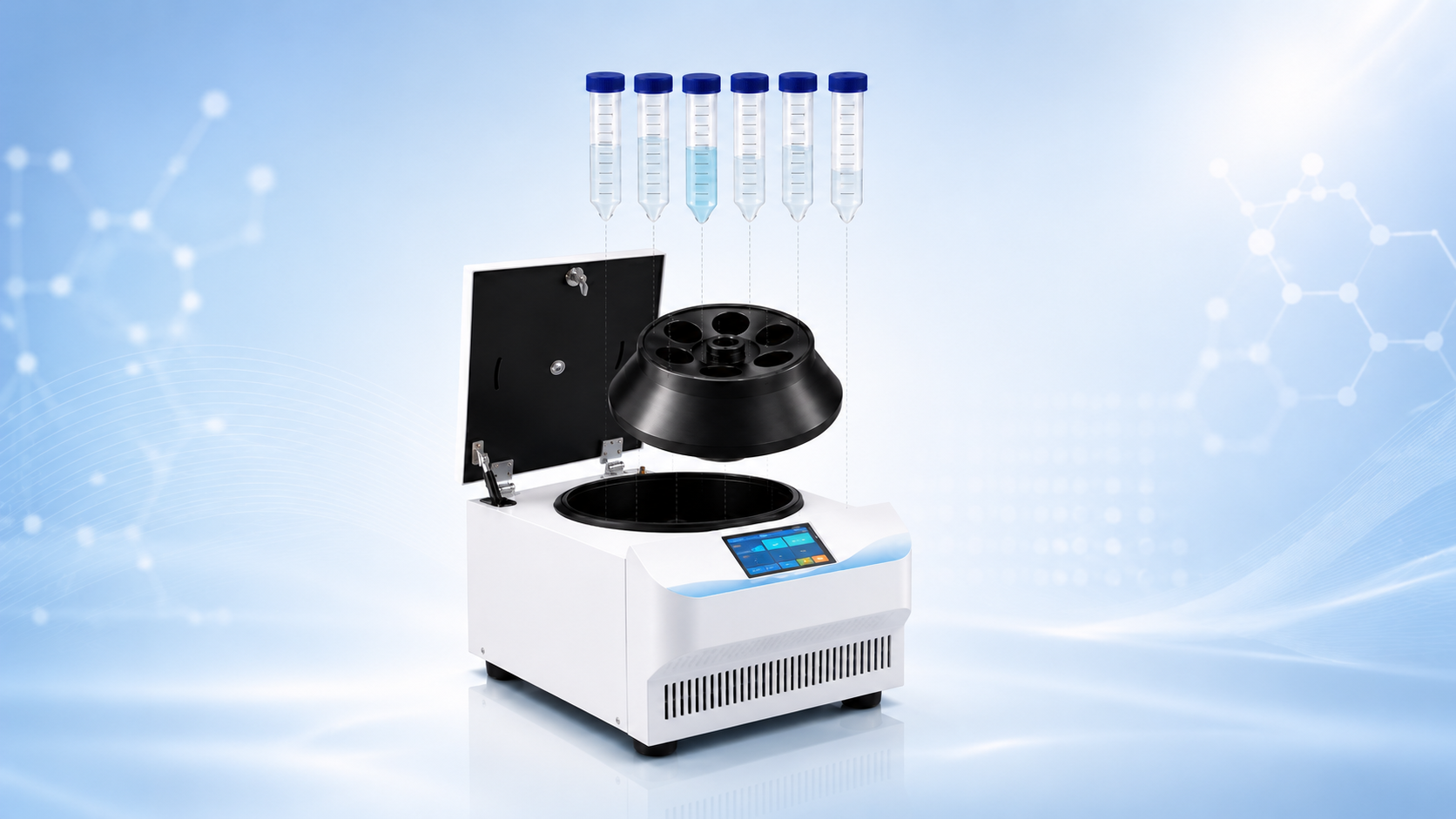
The rotor determines the compatible tube formats, capacity and maximum permitted force. Check the rotor specification carefully rather than relying only on the centrifuge's headline speed.
5. Swing-Out or Fixed-Angle Rotor?
Swing-out rotors hold tubes vertically when stationary and move to a horizontal position during operation. They are useful for applications where a flat, even pellet or clear layer separation is preferred. Fixed-angle rotors hold tubes at a set angle and are commonly used for faster routine separation and compact workflows.
6. Do You Need Refrigeration?
Refrigeration helps manage heat generated during longer or higher-speed runs and may be necessary for temperature-sensitive samples. For short routine spins with stable samples, a non-refrigerated model may be sufficient.
Questions to Confirm Before Ordering
- What sample types and tube sizes will you process?
- What RCF does the protocol require?
- How many samples need to be processed per run?
- Which rotor type best suits the separation?
- Are the samples temperature sensitive?
- How much bench or floor space is available?

Explore the Centrifuge Range
From compact microcentrifuges through to refrigerated high-capacity units, Interlab offers options for routine spins, sample preparation and specialist laboratory workflows.
Compare capacity, speed, RCF and rotor options online, or talk to the Interlab team for help matching a centrifuge to your samples and protocol.
View Centrifuge Range