Choose the unit
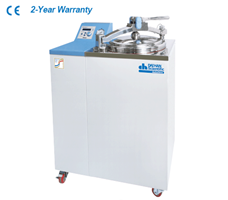
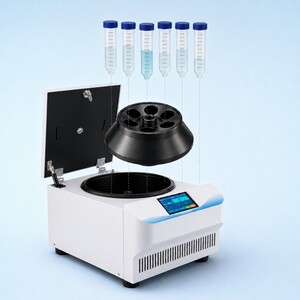
Start with the centrifuge itself. This determines the ceiling for the whole setup: maximum speed, refrigeration capability, capacity, and footprint. Interlab’s range spans compact benchtop units through to higher-capacity floor-standing models, so the first decision is really about throughput and application:
- Benchtop centrifuges – everyday sample prep, small-to-mid volume work
- Floor-standing / high-capacity centrifuges – larger volumes, higher sample numbers, blood bank or industrial-scale processing
Important note: The centrifuge’s quoted maximum RCF is a headline figure, but it’s only ever achievable with the right rotor fitted.
Choose the rotor
This is the step that trips people up. A rotor has its own separate maximum RCF rating, it does not automatically inherit the unit’s maximum. A centrifuge rated to 21,000xg might only reach that figure with one specific rotor fitted; swap in a larger-capacity or larger-radius rotor and the achievable maximum RCF can drop considerably.
When selecting a rotor, match it to:
- Tube/vessel size and volume (see our centrifuge tube range for compatible consumables)
- The RCF your application actually requires
- Sample throughput (how many tubes per run)
Always check the rotor’s own spec sheet, not just the centrifuge’s, before assuming you can hit a target RCF.
Swing-out vs fixed-angle rotors
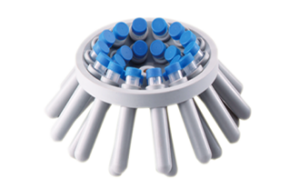
Swing-out rotors hold tubes vertically at rest, swinging out to a horizontal position during the spin. This forms a flat pellet at the base of the tube and produces a gentler, more even separation, which is ideal for density gradients, cell separations, and blood work.
Fixed-angle rotors hold tubes at a fixed angle (typically 20–45°) throughout the run, and samples separate against the side wall of the tube rather than the base. These rotors generally tolerate higher speeds and RCFs, spin up/down faster, and are the standard choice for high-speed and microcentrifuge work.
Neither is universally “better”, it really depends on whether your priority is gentle separation quality or speed and throughput.
Do you need refrigeration?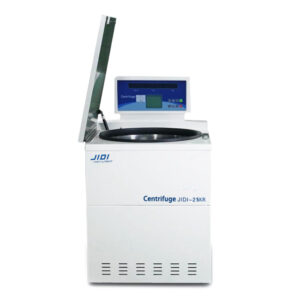
Not always. As a rough guide:
- Non-refrigerated centrifuges are generally fine for samples that aren’t temperature-sensitive, or for short high-speed spins – around 5,000 RPM for 3–5 minutes, where friction-generated heat doesn’t have time to build up too much.
- Refrigeration becomes critical once you’re combining higher speeds with longer run times, or working with temperature-sensitive samples like proteins, enzymes, RNA, live cells, and similar. Extended high-speed spins generate real heat through friction, and without cooling, that heat can degrade or denature what you’re trying to preserve.
If your protocol specifies a run temperature (commonly 4°C), that confirms a refrigerated unit isn’t optional.
Common misunderstanding: RPM vs RCF
RPM is not a consistent unit of separation force. Two centrifuges spinning at exactly the same RPM can apply very different forces to your sample, and that difference comes down to the rotor, not the motor.
RPM (revolutions per minute) tells you how fast the rotor is spinning. RCF (relative centrifugal force, measured in x g) tells you how much force your sample actually experiences, and that depends on both the speed and the radius of the rotor. A small-radius rotor spinning at 4,000 RPM might generate 1,500 x g. A larger rotor at the same 4,000 RPM could generate over 3,000 x g. Same speed, very different result.
This is why almost every published protocol, kit insert, or SOP specifies RCF, not RPM. If you’re following a method written for a different rotor to the one you own, matching the RPM number instead of converting to RCF is a common source of inconsistent results.
The practical takeaway: always select and run your centrifuge based on the RCF the protocol calls for, and convert to RPM for your specific rotor, not the other way around.
Need help specifying a new setup? Get in touch with our sales team – we’re happy to talk through rotor compatibility and application requirements before you buy.