When people talk about poor pH meter accuracy, the meter itself is not always the real problem. In many cases, the issue starts with the wrong electrode for the sample, poor storage, old or contaminated buffers, skipped calibration, or residue building up on the sensing surface. That is why getting a pH meter off the shelf is only the start. A pH meter needs a routine.
If you are regularly measuring liquids, slurries, media, semi-solids or food samples, the best results usually come from matching the probe to the application and following a simple protocol every time. Interlab supplies Milwaukee pH meters, specialist probes, and the cleaning, storage and calibration solutions needed to keep readings stable and electrodes working properly.
Browse the range
Why pH meters seem to “go out of accuracy”
A pH meter is only as good as the condition of its electrode. The glass sensing bulb gradually loses sensitivity with use, and the reference junction can become restricted by residue or sample contamination. When that happens, users often describe the instrument as inaccurate, drifting, slow to settle, or impossible to calibrate.
In practice, that means a pH meter should be treated more like a measuring system than a single product. The meter, the electrode, the temperature compensation, the buffers, and the day-to-day care all affect the result. That is also why two users can have very different experiences with the same model.
Start with the right electrode for the sample
This is one of the biggest reasons people run into trouble. A general-purpose pH electrode may work well in one sample type and perform poorly in another.
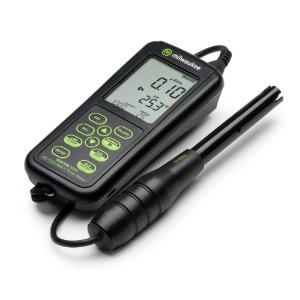
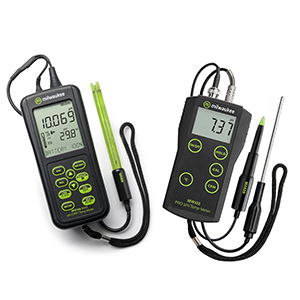
For routine portable testing of general samples, models like the Milwaukee MW101 PRO pH Meter and Milwaukee MW102 PRO+ pH/Temperature Meter are a strong starting point. The MW102 adds automatic temperature compensation, which helps improve consistency when sample temperature varies.
If you are testing semi-solid foods, dairy-style products, sauces, soft cheeses, soups, processed meats or similar samples, a specialist food probe is usually the better option. The MW102-FOOD combines the meter with the MA920B/1 direct measurement food probe, which is designed for direct testing in more difficult food samples.
For users who prefer a refillable glass electrode and want more control over maintenance, the MA918B/1 refillable combination pH probe is another useful option. Refillable probes can be a good fit where users understand electrode care and are prepared to maintain electrolyte levels with MA9011 refill electrolyte.
The key point is simple: do not assume one pH electrode is ideal for every sample. If the sample is thick, dirty, protein-rich, semi-solid, or likely to clog a junction, the probe style matters just as much as the meter.
The protocol that keeps readings reliable
1. Calibrate regularly, not only when things go wrong
Calibration should be part of the routine, not a last resort. A good starting point is to calibrate regularly, use fresh buffer, and recalibrate whenever readings become suspect, after cleaning, or after long storage. For many users, that means keeping pH 4.01 buffer, pH 7.01 buffer, and where relevant pH 10.01 buffer on hand.
As a general rule, calibrate with buffer points that make sense for the range you are working in. If you mainly test acidic samples, 4.01 and 7.01 are often the logical pair. If you work in alkaline conditions, 7.01 and 10.01 may be more appropriate.
For ongoing routine calibration, many users prefer larger bottles rather than sachets, and Interlab also supplies popular 500 mL pH 4 buffer, 500 mL pH 7 buffer and 500 mL pH 10 buffer solutions for regular use.
2. Clean the electrode before residue becomes a problem
Residue on the sensing bulb or around the junction can slow response and cause unstable readings. This is especially common when testing dirty process samples, food, organic material, or anything that leaves a film behind. A regular soak in MA9016 cleaning solution helps remove build-up and restore response.
Cleaning is not just about recovering a bad probe. It is one of the easiest ways to prevent drift, slow stabilisation, and premature electrode failure.
3. Store the probe properly between uses
Storage is where many electrodes are damaged unnecessarily. A pH electrode should be stored in a suitable storage solution so the glass membrane stays hydrated and the junction remains usable. For Milwaukee pH probes, that usually means MA9015 storage solution in the cap, with the cap fitted securely.
What you do not want is a dry bulb, or casual storage in purified water. If a probe dries out, response often becomes slow and calibration becomes harder. Even if the electrode can be recovered, performance may not come back fully.
4. Rehydrate and recalibrate after neglect
If an electrode has been stored badly, left dry, or seems unusually slow, do not judge it too quickly. Clean it, rehydrate it in storage solution, then recalibrate before deciding whether it has actually failed. Many “faulty” pH probes are really just dirty, dehydrated, or overdue for recalibration.
Common reasons pH electrodes fail early
- Using a general-purpose probe in a sample that really needs a specialist electrode
- Leaving the cap dry or storing the probe incorrectly
- Skipping calibration for too long
- Ignoring residue build-up after food, slurry, or organic samples
- Assuming a pH electrode is a permanent part instead of a wearing component
- Not keeping the basic support items on hand from the start
What to keep with the meter from day one
A good pH setup is usually more than just the meter and probe. It also helps to keep the maintenance items together so the protocol is easy to follow. That often means having a calibration solution set, cleaning solution, storage solution, and any refill electrolyte required for the electrode style.
Interlab stocks Milwaukee’s PH-START starter kit as well as the broader calibration, maintenance and cleaning solutions range and electrodes, probes and accessories. That makes it easier to support the full routine rather than replacing an electrode only after problems appear.
We also supply higher-spec pH meters for more demanding work
While a lot of pH problems come back to electrode choice, storage, cleaning and calibration, there are also applications where a higher-spec meter is the right fit. Interlab also supplies advanced Milwaukee options such as the MW106 waterproof logging portable meter and the MW151 bench logging meter for users who need more advanced calibration, logging or bench-based testing. Even at that level, though, good pH practice still matters just as much as the instrument itself.
Quick checklist before you blame the meter
- Is the electrode the right style for the sample?
- Has it been cleaned recently?
- Has it been stored properly in storage solution?
- Was it calibrated with fresh buffer at the right points?
- Has the probe simply reached the end of its working life?
For many users, that checklist resolves the issue faster than replacing the instrument. The real improvement usually comes from matching the probe to the application and following a consistent care routine every time.
Next step
If you are choosing between a general lab-style pH meter, a food probe setup, or a refillable electrode option, it helps to work backwards from the sample. Tell us what you are testing, how often you test it, and whether the sample is clean, dirty, semi-solid, or likely to foul the junction. We can then point you toward the most suitable Milwaukee meter, electrode and support solutions for the job.
If you would like to go deeper into understanding pH, check out the following link: Understanding pH